Today in History - April 30
2012-04-30: Interior Drawing Practices
Here are some photos of my drawing of what is inside a room.

It is a little bit better that the previous drawings.
No comments for this post.
2009-04-30: Jinji Lake – Rebuild Another West Lake
This post was created one months ago, and only show up today.
For people tired of going to West Lake in Hangzhou or The Humble Administrator’s Garden in Suzhou (I mean, after you visit these two places for more than 10 or 20 times), they may be interested to find out somewhere that si near Shanghai, and offers something new. Wendy and I went to Jinji Lake last Tuesday on our six year wedding anniversary. To my greatest surprise, the Jinji Lake has been turned into a new West Lake type of tourism destination, and a Xintiandi type of clustering of modern chain high-end restaurants, and Around-Century-Park type of high-raising residential areas.
How to Get There
Among all the transportation options, driving seems to be the most practical way to get there (do you want to take public transportation just to have a cup of tea along the lake?) It is about 100 km from Shanghai, and takes 1 and half hour to get there.
You can take Shanghai-Nanjing Expressway 沪宁高速 A11 (wonderful newly completely 4-lane expressway) heading Nanjing direction, and turn to Suzhou City Ring Expressway (East) 苏州绕城(东)heading Zhou Zhuang 周庄. Take the Luzhi/Airport Road 甪直/机场路 Exit, and get to Airport Road (a.k.a S343) heading west for 15 km. Jinji Lake is on your right hand.
If you do want to take public transportation, find a train from Shanghai Railway Station to Suzhou Railway Station (pretty frequent – 30 minutes interval), and take Bus 178 to get there. Google Map also suggests that you can walk from People’s Square to Jinji Lake. It costs 16.5 hours, and 81 km. :-)
The Emerging Center
The Jinji Lake is a natural lake that is a little bit bigger than West Lake of Hangzhou (7.82 sq. km v.s. 5.6 sq. km). Just like the old capital Hangzhou to West Lake, the Suzhou Industrial Park (SIP) is the source of the development of Jinji Lake. With huge amount of industrial and commercial activities going on in the park, it is taken for granted that the big natural lake within the area become the entertainment and residential center.
Sitting at any corner of the lake, and look around, you will be amazed by the high raising business towers, and residential buildings. They surround the lake like a curtain. Even you are used to the buildings in Lujiazui, you may still be surprised by the numbers of skyscrapers, and the speed people are building it. If this would have happened to the West Lake, people may say it is a disaster. But in Jinji Lake, the concerns seem to be much less, since this lake on the first day, was designed and built to be a modern West lake – the skyscrapers are also part of the characteristic of Jinji Lake, just like mountains and trees do in West Lake’s example.
Li Gong Di 李公堤
Li Gong Causeway (Li Gong Di 李公堤) is another reason to convince me that Jinji Lake is moving toward the direction of West Lake. The 1400 meters long ancient causeway is now renovated to be a modern street with all kinds of restaurants, and bars.
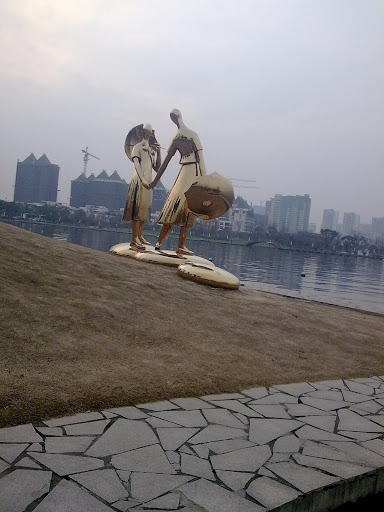
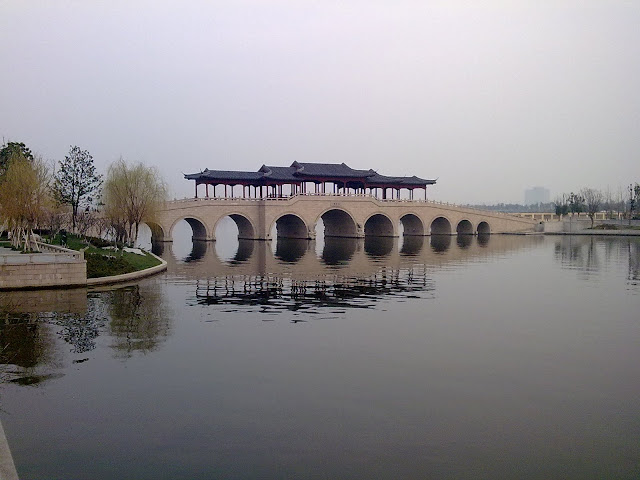
If you have a day to spend, and have been to Hangzhou for so many times, Jin Ji Lake is another option.
2008-04-30: Train Collision in Shandong
The train collision near Jinan killed 71, and injured 416.

Little flower for the victim in the accident
That is too bad. Not to mention those who were killed, I am horrified by the news story of a young man who broke his own arm to be able to escape from the train cart.
When I talked about risk of altitude sickness in Tibet, but to be fair, the risk of living anywhere in China is also high. I don’t want to count the long list of big accident country wide in the past, just to name a few that seems close to me:
A gas station near my home may exploded, killing 4, and injuring 40.
Maglev, which I am both a big fan of in terms of technology, and am writing against it for its cost, can catch fire.
The Metro train also kills. Not only this time, it happened once again, again and again.
If I keep counting the experience I had before I started blogging in 2002, I also can list some terrible accidents I feel very close to:
At the Christmas eve of 2000, fire in my home town, Luoyang, killed 309 – a number till now I cannot believe. When I was in middle school, that shopping center is the closest and the biggest in the area of my high-school.
In the summer of 1993 (July 10, 1993), just one day before I took train from Luoyang to Beijing to visit the capital for the first time, a passenger train No. 163 from Beijing to our direction collapsed with the cargo train in the front, killing 40 people (again, most of them comes from my city). I remember the sad face of the crew of my train after they hear about the news.
These are just few accidents that I feel pretty close to me. There are much more than that in the whole country, not to mention the frequent airlines disaster.
Transportation is a big thing everywhere, but how can I be assured that I am still lucky enough in the next accident? The key question is, who cares after so many accidents happening everywhere? Most of them are because of very stupid mistakes that are so easy to prevent.
I complained about sense of safety in the cyberspace (website can be easily shutdown at any time), it seems we need to move our focus to the safety of lives also.
The country needs some change to make it better. I keep thinking about it….
Comments:
- en
- I think accidents in coal mines is also a big concern in china. I heared many in recent times
- The investigation of the cause of the tragedy is tragedy in itself. Within a few hours of the accident, the official news (or government mouth piece) suggested old and dilapidated rail line; Then, the government cites speeding as the reason; Then the government blames the local railway officials for not sending slow-down notices in a timely manner; Then the premier requests a thorough investigation. Things are really fishy there. (Obviously the deceasd train driver is not a rookie and he is the frequent driver on this rail line. But the dead man has no chance to tell his story NOW!) Without independent and outside investigation, we may never know the true cause of the tragedy and the following suggested reason will surely be denied by the government soon. <a href="http://www.taipeitimes.com/News/world/archives/2008/05/01/2003410740" rel="nofollow">http://www.taipeitimes.com/News/world/archives/2008/05/01/2003410740</a> The unraveling of this (so-called Holy) Olympic terror which has turned so many innocent lives upside down is such a tragedy to behold.
- When I produced my hard hat and wore it, my Chinese boss looked at me sarcastically and told me that a hard hat would not be able to save my life in a construction area.
- I remember a lot talk about the Chinese economy runs like a fast train, and it can not stop, and it has potential to run out of control. The train speed has been raised tremendously in last 15 to 20 years. I remember when I went to school from Ningbo to Shanghai in early 1990s, it took more than 8 hours for the "super fast" (te kuai) train. The potential risk of faster speed is also enormous, so the key is to improve the speed while control the risk. A remote anaology is the rapid developing/changing western financial market, who would like a portion of the US home mortgage (sub-prime loans) will spill over to the whole world in a year? At least Green Span did not think about it couple years ago.
- It's very sad when major disasters happen, no matter where in the world they occur. Seems like no matter how hard we try, there's always a war going on, or a famine, or a flood or tornado or earthquake or hurricane. Natural disasters are one thing, and we can't do much about them. But war, and acts of terrorism, and human error or faulty mechanics causing things like plane crashes and derailments like this one...we humans just don't quite seem to have all the way figured out how to go about this business of living without problems yet. I like the little flower you made, Jian Shuo -- one small remembrance for those who died today.
- safety of life humanbeing is primarily thing everywhere in any reason.
2007-04-30: View before May Holiday
This is the view outside my window – the view before the May holiday. The cloud came and rain is not far away.
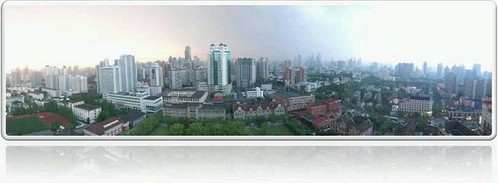
Photograph by Vince Zhen
In the middle is the Shentong Plaza. Before it are the buildings in Shanghai Jiaotong University. You can see the playing ground on the left and the libary (the white tall building). On the right is the People’s Square area….
Comments:
- NICE BLOG~
- Really a very good view~~~ I love it...
- Shanghai Jiaotong University is renowned in compiling the Academic Ranking of World Universities. <a href="http://www.webometrics.info/" rel="nofollow">http://www.webometrics.info/</a> Many students use this guide as the yardstick in selection of the university.
- You too, Kenneth!
- Thank you Jian Shuo! Wishing you have a great holiday!
- The bigger picture is here: <a href="http://farm1.static.flickr.com/222/478195204_0a201f8805_o.jpg" rel="nofollow">http://farm1.static.flickr.com/222/478195204_0a201f8805_o.jpg</a>
- Nice view, but would even better if the picture is larger.
2006-04-30: From Shanghai to US – A Handbook
I am writing this short guide to friends who are going to U.S. for the first time. What I did in the last few years is a little bit different. I used to introduce Shanghai to first time visitors from foreign countries. To be honest, most of the articles answer questions I received from email, from my foriegn friends. For other topics, I just imagine what people may encounter, since I don’t have first hand experience about how the life of a foreigner looks like. What a pitty. For example, I totally have no idea about hotel information since I never stayed in any hotel in Shanghai.
For this short guide, it is more practical. They are problems I encountered myself and the solution I found out. (So don’t expect it to be the most accurate and perfect solution).
I am going to complete it in the next three months, with 5 to 10 articles. This is not my style though. I was not good at planning, or strategy in business term. I am practicing now. :-)
Here are the table of content.
- U.S. Visa Application (suggested by DC)
- Flight from Shanghai to U.S.
- What to Bring with You.
- The Airports (both in Shanghai and in San Francisco).
- Transportation without Renting cars.
- Renting a Car in U.S. with Chinese Driver’s License
- What to Buy, Where to Buy and What to Bring Back to China
- Food (suggested by Carroll)
- …
- …
- …
The …’s are place holders. Let me know what questions you have. I won’t have complete answer to everything, just my very limited travel experience (6 times?) to the west coast of U.S.
Many topics were covered before. If so, I directly link to that entry. If I don’t have it already, I write it later.
Comments:
- I wish I could be there someday. Many thanks for your information and I just find myself even getting addicted with your blog recently... Nice job, keep on going. :-)
- Now people in Shanghai can exchange USD up to 20,000 USD per year without other limitations. Just go to bank to exchange.
- How about changing Chinese money into US dollars? Particularly if you don't work full time (and therefor don't have a tax receipt to show the bank). Customs is a good topic. In addition to tipping and not yelling at staff I suggest "don't spit", "don't litter", and "how to stand in line".
- Yes. I heard about Purple Mountain Hotel, but never been there. Any information about this hotel?
- I know it's off the topic, but you mentioned hotels in Shanghai. I can recommend the Purple Mountain hotel. The rooms are very well designed and comfortable, and the hotel has a lot of amenities. If people do have questions regarding travel to various parts of the U.S., post it. Those of us who live here can probably help with answers.
- I'd also recommend taking a look at this article: <a href="http://www.iht.com/articles/2005/10/21/business/tourists.php" rel="nofollow">http://www.iht.com/articles/2005/10/21/business/tourists.php</a> "Chinese tourists getting a bad image"--NY Times.
- You should also add "what not to bring into the US" and I imagine high on that list should be pirated DVDs. There are a number of stories moving around the grapevine in the Chinese expat community about people who got nabbed at the US border with some pirated DVDs and being fined on a per disk basis. And the fines are steep--something like $1,000 or $2,000 per DVD. You may also consider a section on general cultural attitudes and tipping when it comes to waitresses, hotels, and other service employees. It goes without saying that the tirades of abuse I've seen hurled at wait staff in many a restaurant on many a day in China would get you physically thrown out of many American restaurants.
- zjemi, low quality but cheap is the first stage in development. There must be enough quantitity of goods to produce to drive quality - when there are enough initial funding to support R&D, quality control and other expertise, the product can be better, and finally, bring its own brand. I believe it is the way to go. RC, welcome back, and it is good to know you finally have access to Intenret. DC, and Carroll, I have added your suggested topic to the list. Hope to complete it in the next two months (I seldom make plan for longer than 2 month for my personal life).
- What a great project! Be sure to include a warning about all the "rabbit food" we eat over here ;-) Happy May Day to you and Wendy!!
- JS, maybe you would like to include th topic US Visa application from your previous articles. Especially the procedure like how to make payment and fill in the various type of forms. That will be helpful for those who are going to US for the first time. And, is it the same procedure for those who are not China citizen but staying in China? :)
- I almost forgot, Happy May 1 holiday to Wendy and you!!!
- I believe people will find this to be very useful Jian Shuo! And I bet you're better at planning and strategy than you give yourself credit for!
- Although I'm an American, I'm really interested in this project. And I'm especially looking forward to the "what to bring back to China" since most of the presents I can think of to give Chinese friends have been made IN CHINA. Note, yesterday I found out two things that may be a sign of a big shift in U.S. perceptions. 1. Dragonsoft for webconferencing is a terrific program, better than the U.S. made products, and easier to use even for people like me who can't read much Chinese. 2. Batteries for a Canon camera made in China for $11 US are better than the batteries from Canon that cost $80. This shift in quality is a big thing. There was a time in the US, 50 years ago, when Made in Japan meant "low quality". Of course all that changed. Now things made in China are considered, by most people, to mean inexpensive and not as good. The second meaning is about to disappear. Wow.
2005-04-30: May Holiday at Lijiang
I will be at Lijiang and Lugu Lake area in the May holiday. :-) and will get back on May 3. I don’t have the same expectation as I had for the Daocheng trip, but I believe it is some place for me to sit in the Sun and really enjoy the peace of life.
Comments:
- Lijiang has a great natural environment and a peculiar sense of history. The so-called Naxi Ancient Music is really Han Chinese music left over from the Ming Dynasty. Real Naxi music is lilting and very beautiful, but sadly there are no performances of this. There are good performances of Tibetan (those traders who established the Tea and Horse Trade Caravans that created Lijiang in the first place) and Lugu Lake area music and dance at a restaurant and pub called Highland Gale. It is the only remaining ethnic performance in Lijiang, but it is very well done. Sadly, the Naxi "culture" in Lijiang has pretty much turned very commercial, commercial enough to turn the stomache, some would say. You can't even take a photo of someone without having to put up with a demand for ten yuan compensation. If you think the 6 hour drive to Lugu Lake is a bit much (it will be better in 2010 when the new road is finished), a two or three hour drive to Liming ( the northwest of Lijiang) may suit you better. Liming is an area of red cliffs and very friendly Lisu people. If even that is hard on your stomache, a half hour trip to Wenbifeng peak to hike around Wenfeng Temple will not disappoint. The walls are full of colorful murals, the lamas are friendly and will offer tea, and the hike up the hill behind the main temple is lovely. And the place has terrific views of the Lijiang valley. .
- Very-very thanks for your profile.
- ...your pictures are terrific, I am considering a summer holiday there... did you book a airticket+hotel package from some agent, or you arranged everything by yourself ?
- Harald, yes, maybe we have met in Lijiang but we didn't recognize each other. :-) Enjoy you trip to Lhasa. Me? I have returned to Shanghai.
- Hi, as a frequent reader of your blog I just found out that it was likely to meet in Lijiang these days ... even I am sure you experienced the mass of tourists during the may holidays. I am on my way to Lhasa now and will enjoy the good air ... sorry, but living in Shanghai makes someone looking forward to this ;-)
- I want to send you an email but can't find your email addresss, though I read it before. I failed to open the ABOUT ME. I don't know why.
- I want to send you an email but can't find your email addresss, though I read it before. I failed to open the ABOUT ME. I don't know why.
- Lugu Lake is very nice. Lijiang is nice too, but must be very crowded. It was very difficult for me to find a place to stay when I visited there in summer a few years ago. You can visit a small town Su4 He2 (束河),similar to Lijiang, just 20 minutes by bike from Lijiang. The layout of the town is the same, just in a smaller size. It is quiet there with fewer tourists.
2004-04-30: Get India Visa in China
After I setup this site, I am often mistakenly regarded as Mr. Know-Everything… I am surely not. I only took the advantage of knowing both Chinese/English languages. :-D
XHJ asked me about how to get India visa for Chinese citizen. I didn’t know that before, but I saw this information may help XHJ to get married with the girl he loves. I read some Chinese website and got the following information:
Visa Type: Business Visa
Valid period: 2 months
Max days to stay: 30 days
Requirement: All passport visa holder
Materials needed: two 2′ photos, photocopy of national ID (both side), passport valid for 9 months.
Source: http://www.china.org.cn/chinese/TR-c/215864.htm
More information on India Visa:
- Yun Nan Travel (Chinese site)
- EU Trip (Chinese site)
Comments:
- Dear Sir, Could you please help with india visa in chengdu, china? I was searching on some websites but couldn't found any information about.. I am not a chinese citizen and need a tourist visa for one month. Sincerely appreciated, Soleil
- Dear Sir, Please let us know if a china citizen want to apply for a Indian Visa for 3 months,what is the formalities and how to obtain the Visa. When i searched the internet, I found that only chinese citizens can apply from hongkong/beijing. Any help in this regard will be much appreciated. It will be a great help if you can provide the information asap. Thanks and Regards
- Please let me know, Incase i wish to bring any of my friend who is a chinese citizen to India, Then what is the formalities and who do she get visa for the same,
- For whom it may concern, If i've got an indian job offer,how can i get all the procedures through ? And it's an indian company registered in india and not in China,i'm sending my profile and CV to the office in india and the indian side would take care of the chinese embassy in india,i may be shifed to their beiijing office.do i need to get a passport and visa? tks and rgs echo
- Dear Sir/Madam, Please let us know if my chinese girlfreind want to apply for a Indian Visa for how long can she get and what is the formalities and how to obtain the Visa. We are planning to get married in India, so will require a longer period visa. Please advise me on the same, i would be grateful. Awaiting an earliest response. Thanks and Regards Joseph Fernandes
- a whant address for indian embasy in shenzhen CHINA
- Respected Sir, i want a detailed information about VISA in china for a conference purpose. application form , charges for a VISA, offices where in i get VISA, etc. all information please send me on my e-mail id which is given to you by this e-mail thanking you dr.j.r.bhor
- yuvraj thakur can iappliy visa for marriy there girl find thaking you
- Dear Sir, Please let us know if a china citizen want to apply for a Indian Visa for 3 months,what is the formalities and how to obtain the Visa. It will be a great help if you can provide the information asap. Thanks and Regards Imran
- Hi There, A friend of mine is a german citizen who is currently in Shenzhen, PRC. He wants to visit me in Chennai, India. Can you help me with where he can apply for the visa and the procedure to be followed??? When i searched the internet, I found that only chinese citizens can apply from hongkong/beijing. Any help in this regard will be much appreciated. Regards Srikrishna
- Obviously you are not Mr. "know everything". Here is the link about how to process visa to India: <a href="http://www.south-asia.com/Embassy-India/consular.htm" rel="nofollow">http://www.south-asia.com/Embassy-India/consular.htm</a> good luck!
- English version: <a href="http://pakistanidefence.ipbhost.com/index.php?showtopic=27425" rel="nofollow">http://pakistanidefence.ipbhost.com/index.php?showtopic=27425</a>
- the comparison between China and India: <a href="http://www.wforum.com/wmf/posts/4099461.html" rel="nofollow">http://www.wforum.com/wmf/posts/4099461.html</a>
2003-04-30: SARS Shanghai – April Review
It is the worst of time. April is the hard time for people in China – among the worst in my life (26 years). The impact to everyone’s life is comparable with the year of 1989 and the flood in 1998. Today is the last day in April so we have some time to review the whole SARS event in this month – actually, all major events related to SARS happened in the month of April in China.
To open the links in this page in a new browser window, press SHIFT key while clicking on the links.
Statistics
Up to 10 AM, April 30, 2003, there are 3460 SARS cases country-wide. Among them 1440 cases were in Beijing. (Source: Sohu.com)
On Wangjianshuo’s blog, 24 articles were devoted to SARS, including 2 in March and 2 in Feburary. 322 comments were left in one month around the topic of SARS.
Summary
The course of development of SARS epidemic, the preventional actions and the media reports of SARS in China can be clearly divded into three stage, seperated clearly by two events:
1. First media conference on April 3, 2003, when Minister of Health first announced the SARS to the media.
2. The second media conference on April 17, 2003, immediate after which the sack of two officials were announced.
I will call the three stage as:
- Stage 1: Few reports, no actions.
- Stage 2: Lots of reports, few actions.
- Stage 3: Intensive reports, solid actions.
Let’s review the articles on SARS on Wangjianshuo’s blog to see the stages.
Stage 1: Few reports, no actions.
 Feb 12: I first heard of atypical pneumonia from my classmates in Guangzhou on Feburary 12 (maybe few days before). I didn’t realize that this will be a global problem.
Feb 16: For days later, China Daily reported atypical pneumonia was under control. I was very happy to know the news. However, as I wrote, the anxiousity was not under control yet.
Mar 23: My friend asked me on MSN Messenger that “is it (SARS) bad in Shanghai?”. Well. I didn’t know anything about SARS at that time. It was the first time I heard of the term of SARS.
Mar 26: I was educated by the symtoms of SARS.
Mar 27: SARS hit the headlines of local newspaper for the first time. It said “there is no SARS in Shanghai”
Apr 1: SARS begin to cause a little bit panic in the city. People who have access to emails are among the first batch to get the rumor of SARS. Actually, the rumors sounded very scary. Most of them, however, proved to be completely fake two weeks later. Meetings began be to postponed.
Stage 2: Lots of reports, few actions.
After the media conference, the ban of newspaper report on SARS was lifted. Media began to discuss about SARS publicly.
Apr 6: Shanghai looks good since the rumor discontinued because of the media coverage began.
Apr 8: My expat readers began to participate in the discussion about their feelings about SARS in the city. SARS was a much more serious issue for them.
Apr 9: I said “Panic under contrl, SARS may not“, because although the media repeatly report there is no SARS cases in Shanghai, or there is only one SARS case in Shanghai later, I didn’t see any preventional actions around me yet.
Apr 10: Hospitals and hotlines setup in Shanghai.
Apr 11: More and more people from abroad were asking me “shall I cancel my trip to Shanghai?“.
Apr 15: Lots of SARS websites were put online.
Apr 17: This is the first article of my Daily Life in Shanghai. The positive sides is, all media (radio, TV, newspaper and websites) are talking about the preventional measures of SARS. The dark side is, the taxi driver told me they never disinfect their cars although TV news report said so.
Stage 3: Intensive reports, solid actions.
April 20 is the turning point. It is rare that a official were fired for their fault. After the sack of former health minister, the officials of the whole country were shocked and quick actions were taken.
Apr 20: 339 SARS in Beijing. May Holidy Cancelled.
Apr 22: All evidence proved that China is taking SARS seriously. Disinfection of the buildings and announcement of dangerous trains with SARS suspected patients happened.
Apr 23: Situation of SARS in Shanghai became severe. Disinfection went to the next level and the eight regulations from the Shanghai government really impacted everyone’s life – travel outside Shanghai restricted; masks for most service industries became must; temperature were taken at all ports.
Apr 24: Pictures in Beijing and Shanghai are better than thousands of word: the situation is worse, but the actions were solid.
Apr 25: The whole nation became more united than ever. Solidarity became the first priority. People of all industries and all cities were fighting agaisnt SARS. Moving stories hit the headlines of newspapers. I posted “Protect China – Not Only Against SARS” in response to the false report of some medias on China.
Apr 26: Daily Life – SARS related II. You will see very encouraging changes in Shanghai about the thorough work the government have done. It was the second reason why the city of Shanghai had much lower case of SARS. (The first reason was purely lucky).
Apr 27: WHO finally released the findings of the five-day investigation. It was a positive one.
Apr 28: Check what it was to have a dinner now in Shanghai.
Apr 29: Daily life – SARS related III. I felt safer now, although the threats of SARS were still there.
Apr 30: SARS Shanghai – April Review (this article) came out.
Comments:
- im Osten durch die Bigorre und im Süden durch Spanien.
- Hello, first time here and wanted to say hi
Comments: