Maglev Accident in Germany
By Jian Shuo Wang on 2006-09-23 23:16 · MaglevWhat happened in the Maglev in Germany? Why two trains can possibility hit each other? On the advertisement of Maglev in Shanghai, they use the tag line “Experience almost 900 km/hour speed when two Maglev passes each other…”.
I can imagine it is definitely not funny if they do not pass each other, but hit head to head.
I am so sorry for people who lose their lives. As the Germany president put it “It is completely unacceptable for their family or friends to say by to them in the morning but found out they never go back home again….” I share the pain of the families.
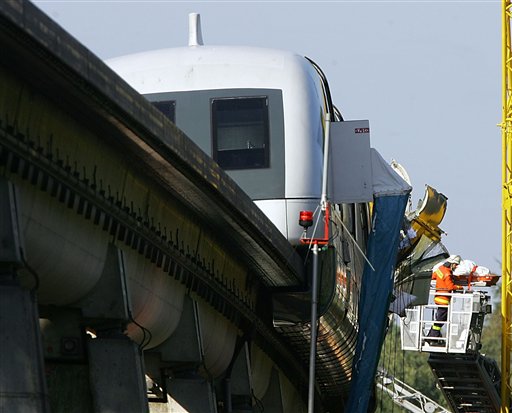
Image in courtesy of cbs news
There was fire on Shanghai Maglev before. This makes the future of Maglev not so clear…
22 Comments
In 99.9999% of time, a maintemance vehicle should not be on the same track as the oncoming train.
I think this tragedy would only happen in this unique situation of a "test run".
When everything is setup for production run everyday, the chance of hitting a maintenance car is almost non-existent.
So, I don't particularly worry about this kind of accidents repeat again, ever.
Now the lesson to be learned: Don't take part in any test run or maiden voyage, even if they are offered to you for free.
I think everybody knows about the tragedy of Titanic some 100 years ago.
I may have strayed too far away from this particular subject, in business world, the same lesson can be learned: Don't be the first to adopt a new technology and bank your fortune on it. Otherwise, you could be a perfect test guinea big.
But my question is, why with this kind of high technology, they didnt include a safety feature in the train that can detect static object few km away and try to stop the train slowly.
maybe they need to install a 'maglev camera' track at the side of the train track for surveilance purposes.... the camera will go ahead 30secs or 1 minute earlier before the real maglev depart from the station.
mop
CJ
In any case it is most safe to sit in the middle of the wagon, and your face should be opposite of the driving direction. No passengers must sit opposite you, as they will hit you if an accident happens.
I know that it is not as exiting as the thrill of facing the driving direction.
The Maglev MUST install seatbelts, just like in an airplane !
To wear them or not might be a personal question, but they should be available.
Anyway, all transportation is dangerous. Ferry, train, car bicycle, walking.
To compare Maglev with another fast transportation, see the many records on :
http://www.airdisaster.com/cgi-bin/database.cgi
Will you stop flying ?
If you disregard human error, Formula 1 race cars are the safest mean of transportation of all.
In this case, everything has to do with the technology:
*) First, why a maintenance vehicle was wandering on the way?
It is written everywhere that thanks to the marvellous technology, no track maintenance, or very little, is required. Actually, since the Maglev is "flying" above the track, at a very low altitude (about 5 cm), anything bigger than a centimetre is a potential danger to the train. Any gravel, piece of wood, branch, etc. would be caught under the train body and hit or tear it at full speed. This is why the track has to be swept before the first passage, to make sure that such element does not remain on the track (and what about a kid, or a terrorist, just sending a small stone on the track deck from the ground between two trains during operations hours. Not very difficult). And it has to be made very carefully, since they are not searching for big things, but precisely for small items. Technology.
There is also a need for sweeping train on high speed tracks, before the first train runs at full speed, but just to check track integrity, not to accomplish any work.
*) Second, why the maintenance vehicle was not detected?
Because it is a non maglev vehicle, special for sweeping, that cannot be automatically detected by the system itself. Technology.
On the contrary, a maintenance train on a high speed track is automatically detected by the track circuits, like any other train. Small working tools are not detected, but they are not a threat to the trains, and the sweeping train runs first for that.
*) Third, why so many casualties ?
The front car was completly destroyed, unlike vehicle in a conventional train accident at this relatively low speed. It seems that the vehicle resistance is not at the railway level, that would explain why the information about resistance has never been available, and why the vehicle remains relatively light. But what would be the performance (acceleration, speed, energy, noise, passenger load, etc.) of the Maglev if it had to comply with standard regulation on vehicle resistance? Technology.
Another reason is that the elevated track, with no sidewalk, makes difficult for emergency services to reach the accident site and to assist and save people. Technology.
Pretending that the technology has nothing to do with this accident, but human error is the cause, is just like saying that guns have nothing to do with crime, but bad guys are the cause.
We've heard that before. But that does not protect lives, just big companies' money.
Tests to cease on Emsland guideway
"This is not the end of the Transrapid maglev technology!, arffirmed Transrapid International on April 2 last year after the proposed 37 km maglev line linking Munchen city centre with the airport was abandoned. The words returned to haunt the company on December 10 when Niedersachen Economics Minister Walter Hirche announced afeter a meeting with federal officials and industry representatives that testing on the Emsaland test track would cease on June 30 2009.
Ever since the world´s first passenger carrying maglev vehicle was unveiled to the press at Ottobrunn on May 6 1971, Germany´s maglev technology had been heavily promoted across the world by its suppliers and -more equivocally- by successive German goverments. After 37 years of tests and experiments, the 31 km Transrapid operation between Shanghai airport and Pudong remains the world´s only commercial high speed maglev. Over the same period, according to UIC figures, 9400 km of high speed railway with steel rails have been commissioned, with a further 8295 km under construction. Need we say more?"