How to Read Shanghai Bus Stop Plate
By Jian Shuo Wang on 2005-11-24 22:53 · BusEdward told me he is still confused when he read Chinese Bus Stop Plate in Shanhgai after living in the city for 3 years. He came from UK and travelled a lot in China. The most confusing part is about the difference between “Upward” and “Downward” route. Let me try to help explain it.
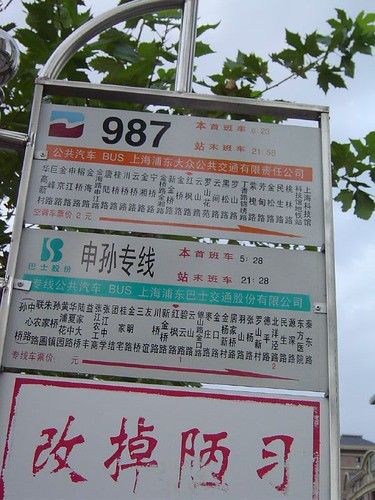
A typical bus stop plate in Shanghai
Here is the informaiton on the plate. People who do not understand Chinese may also recognize the information.

© Jian Shuo Wang
The one in the middle is a route with Chinese name. It is similar.
Upward and Downward
Many bus stops are wired. If you leave a bus at one stop, and after you get back and go to the opposite site of the road, you cannot find the bus stop to go back. It happens all the time. It is because there are just too many single-way roads in Shanghai that makes it impossible to get back on the same road. So the route of buses going to one direction may differ slightly from the route going to the opposite direction. I also get confused when they use “upward” or “downward”, because I don’t know what is the definition of up and down. Upward may mean “east to west”, or" “west to east”, “south to north” or “north to south”. Anyone can explain it?
Ask the driver or the bus conduct to get more information about where the bus actually stops, since two bus stop with the same name (typically the name of a road) may be very far (say, more than 10 km away) from each other.
22 Comments
How is the public transit in shanghai. Are most people satisfied with the service? Will people choose to ride bus or subway althogh they have vehicles at home?
Bus service in suburban Toronto is really terrible.York region is running a new service. However other than the "high-tech" (for example, it has digital plate and real-time schedule information), it doesn't provide any practical benefits. Soon after the initial curiosity, not many people are happy with it.
I really feel sad about the "no-future" public transit service here. I hope shanghai can do a better job.
There are lots more slogans like this in one of the un-used plates at a bus stop, such as "Don't spit on the street", "Speak Pu tong hua (Mandarin instead of Shanghai dialect)", "Use polite language", "Please use pedestrian crossing" etc.
I always wonder what is the point of these slogans because people still spit wherever they feel like, still cross the roads whenever they want, even piss wherever they want.
Also, a note to accompany Wang Jianshuo's diagram: the start and stop times on the bus stop sign are the times for that particular stop, not for the entire line. I find this very convenient and helpful.
It doesn't actually mean direction. Just to indicate going from Terminal A to B, and from Terminal B to A.
The sample plate you put there is not a perfect example. On some plates, there will be two names written side by side with one put in parenthesis. For example, Beijing West Rd. (Shimen No.2 Rd.). This means when you go from Terminal A to B, the stop is called Beijing West Rd, and when you go from Terminal B to A, it is called Shimen No. 2 Rd. In other words, there is no return stop on the opposite side of Beijing West Rd, neither of Shimen No. 1 Rd. These two names share the same spot only on the plate, but not so when it comes to the real stops.
Hope I've made it clear. :-)
And to Sabrina, totally agree with your "get rid of those silly + ugly slogans" as those who are doing it won't just give up the "陋习" by reading the them, maybe some of they can’t even read anyway...
Talking about baby-sitting government, china is not the only one in the world, and I guess if the government really mean it they could have had better ways to handle it, instead of just with the ugly paint fading slogans...
Finally spitting in streets, yuk! The most disgusting habit, but guess what? Have u ever seen well-dressed banker spitting in street? : Yes I have! and more than once, in London near Bank station.
Well anyway that's enough of me babbling. Sorry jianshuo for going off your wonderfully helpful topic :P
I will be going to shanghai with 2 other friends in end of dec. Would like to ask u where can i check the daily train timetable from shanghai to suzhou and hangzhou.coz need to plan my trip and book hotels. Or do u happen to know the timetable??
Thanks!!!
I suspect that the "upward" and "downward" is a legacy of the possible British beginnings of the Shanghai bus service?? In Britain, the habit was to talk about going UP to London or DOWN from London. The railways refined this to talk about trains being UP trains or DOWN trains when running to or from a major terminal . So I suspect that Up busses go TO the major terminal and you go FROM it on a DOWN service. So compass direction has nothing to do with it. You just need to know which is the major terminal :-).
T732 7:00-7:47
T706 9:00-9:48
T708 10:00-10:47
T712 10:00-1047
N504 11:13-12.28
T714 12:30-13:17
T716 13:15-14:12
T740 14:10-14:57
can you read chinese?you can look www.ctrip.com.
shirley
I think you have misunderstand it.
When the name is close and with a bracket, it usally means the detail place of Stop.
In you example, Beijing West Rd. (Shimen No.2 Rd.) it means the stop is in Beijing West Rd. and near Shimen No.2 Rd. or in Shimen No.2 Rd near Beijing West Rd.
"upwards" and "downward" only appear in the map.
If it is a usual map solded at bookstore, downward means from first to end, while upward means end to first.
For example , one bus in the map is Yan An Rd, Huaihai Rd, Fuxing Rd. downwards mean from Yan an Rd to Fuxing Rd. while upwards from Fuxing Rd. to Yan An rd.
If it is the map in the bus, there usually have 2 line(usuall one blue, and one red) to indicate the different dierction.
I was wondering if there are any direct train routes from Hangzhou to Suzhou/Wuxi. It seems like they all have to pass thru Shanghai first. Is it true?
kunica
I think it is only who design it doesn't think it need a detail info, since the road is very short in the first, and this become a custom.
But now, it will be changed, the new or changed stop plate will use "double road name" such as "Chongqing Rd. Yan'an Rd.". But it need a time.
I think the bus stop plate will be all use "double road name" in five years.
There is one link on the page whereby you can download the whole list .
I suspect that the "upward" and "downward" is a legacy of the possible British beginnings of the Shanghai bus service?? In Britain, the habit was to talk about going UP to London or DOWN from London. The railways refined this to talk about trains being UP trains or DOWN trains when running to or from a major terminal . So I suspect that Up busses go TO the major terminal and you go FROM it on a DOWN service. So compass direction has nothing to do with it. You just need to know which is the major terminal :-).
Posted by: unclejohn on November 28, 2005 4:20 PM
----------------------------------------------------------------------------
i agree this point of view. i was taught this by my elder brother when i was young. He told me Upward means from contryside to the city center, Downward means from the city center to contryside.